Addicted to Page One? Why Launching a "Copy-and-Paste" Website Can Get You Penalized by Google
|
Few moments in business are as rewarding as seeing your corporate website break through to Page 1 of Google. High-intent inquiries start arriving, sales conversations begin with pre-qualified prospects, and your marketing ROI hits record highs.
Recently, a client we helped achieve top rankings in Malaysia experienced this exact surge. But along with that success came a tempting kind of "addiction." Seeing how lucrative Google search traffic had become, he approached us with an idea: |
 |
| |
| “Can we just copy and paste this entire website under a new domain name? That way, we can own two spots on Page 1 and double our corporate inquiries overnight!” |
|
| — Excited Business Owner |
|
|
|
 |
|
On the surface, the logic seems simple: if one shopfront brings customers, why not open an identical one right next door?
In Google search, however, this shortcut is one of the fastest ways to destroy years of hard-earned visibility. |
| |
1. How Google Handles Duplicate Domains
|
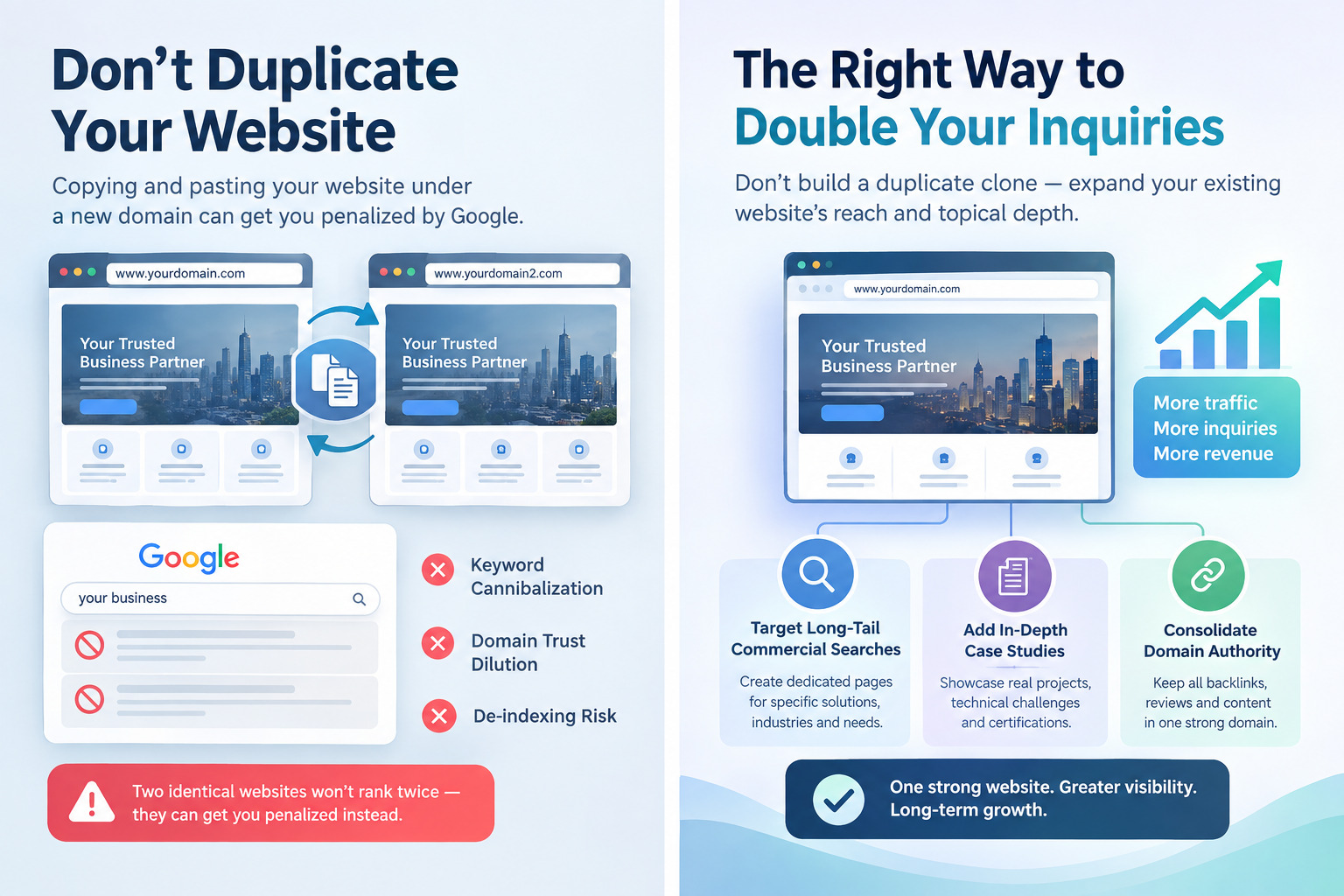
| Google’s algorithms are built to deliver unique, helpful, and distinct value to searchers. When a business creates a second website featuring identical text, duplicated service pages, and mirrored layouts, search engines flag it immediately. |
|
| The Business Assumption |
The Algorithmic Reality |
| “We will occupy positions #1 and #2 on Page 1.” |
Keyword Cannibalization: Google actively filters out near-identical content. Rather than showing both, Google consolidates signals or suppresses the second domain completely. |
| “It doesn’t hurt our original, ranking site.” |
Domain Trust Dilution: If Google determines that two domains are intentionally manipulating search results through doorway tactics or duplicated networks, algorithmic downgrades can strike both websites. |
| “It is cheaper and faster than doing more SEO.” |
Complete De-indexing Risk: If Google issues a manual spam penalty, both domains can be dropped from search indexes entirely, wiping out existing inbound leads overnight. |
|
| |
2. What Really Happens Behind the Scenes
|
- Google Detects the Digital Footprint: From domain registration data and server hosting environments to matching page structures, Google easily connects the dots between sister sites.
- Authority Gets Diluted: Search engines need clear signals on which domain holds true industry authority. Splitting your brand equity and backlinks across two cloned sites weakens both, allowing competitors with a single, focused website to outrank you.
- Violation of Spam Guidelines: Creating cloned websites to dominate search results directly violates Google's Spam Policies regarding scraped content and doorway domains.
|
| |
3. The Right Way to "Double" Your Inquiries
|
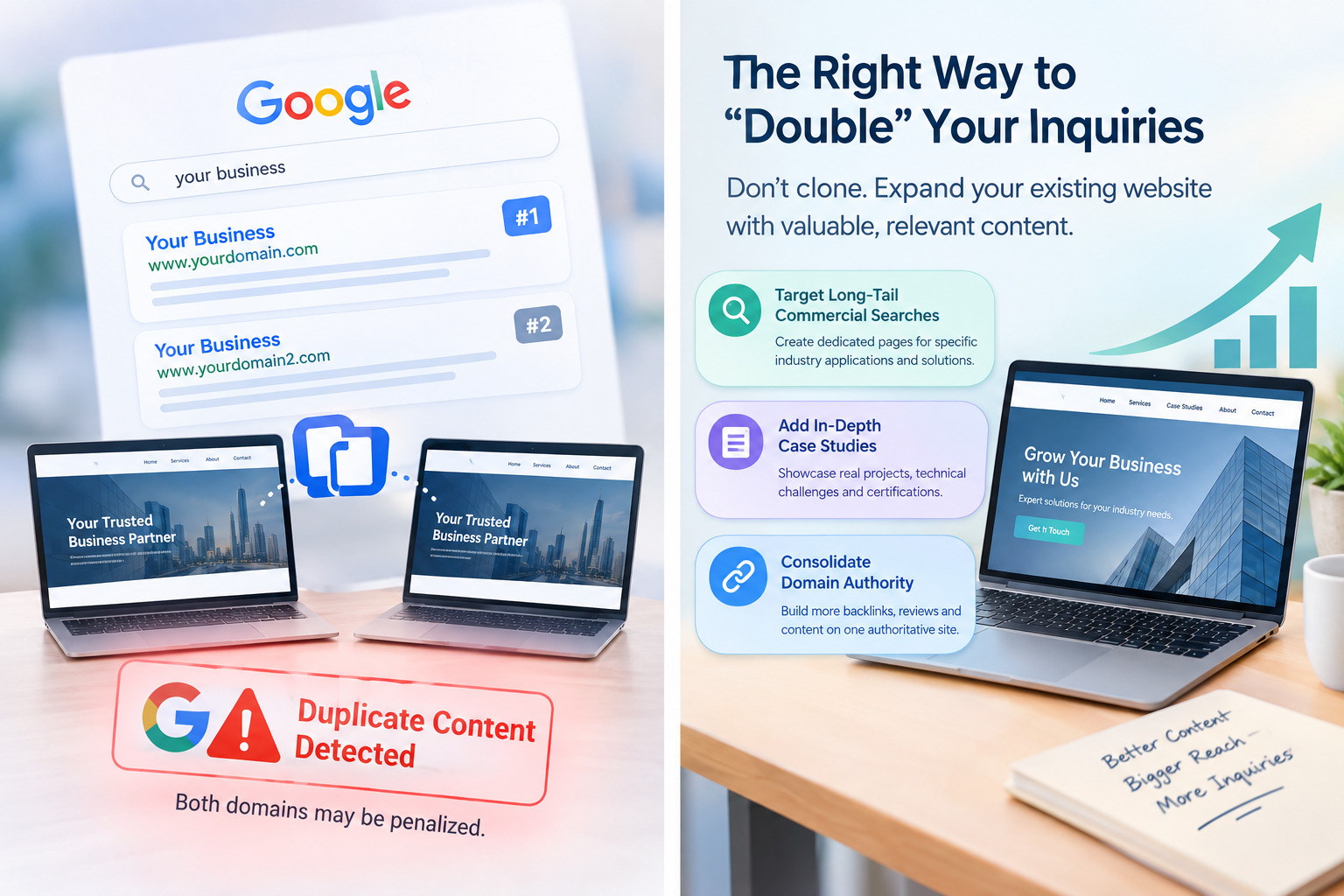
| If you want more revenue from Google, you don’t build a duplicate clone—you expand your existing website's reach and topical depth: |
|
- Target Long-Tail Commercial Searches: Instead of competing with yourself for the same few keywords, create dedicated pages targeting specific industry applications, technical solutions, and corporate needs.
- Add In-Depth Case Studies: Showcase real client projects, technical challenges solved, and certifications that prove your expertise to both Google and prospective buyers.
- Consolidate Domain Authority: Funnel every new backlink, project review, and article into a single, authoritative digital asset that becomes harder and harder for competitors to displace.
|
|
 |
| |
Our Advice for Business Owners
|
When business owners tell us, “We plan to promote on Google,” our first priority is to make sure they build on a solid, lasting foundation.
Search visibility is an incredible growth engine, but cutting corners carries serious risks. Protecting your digital reputation and Page 1 rankings requires strategic architecture, high-value content, and strict adherence to search engine guidelines. |
|
| Webteq is a website company since 2007. We build effective websites that protect and grow your digital presence. |